
I have always loved Rudyard Kipling’s uplifting poem If— a famous didactic poem written as advice to his son, outlining how to live a virtuous, resilient, and honourable life through self-control, humility, and integrity. It serves as a blueprint for maturity, encouraging readers to handle triumphs and disasters equally, persevere through challenges, and maintain composure. It’s too long to repeat here, but easily available. Just a few lines …
“If you can dream—and not make dreams your master;
If you can think—and not make thoughts your aim;
If you can meet with Triumph and Disaster
And treat those two impostors just the same.”
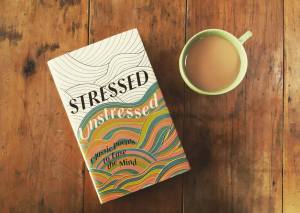
Wandering through one of those increasingly rare independent bookshops on a rainy Sunday afternoon, I picked up Stressed, Unstressed – a collection of over 100 ‘Classic poems to ease the mind’. Published by William Collins in 2016, the poems are categorised into groups such as stress-beating, meditating, stopping, grieving, moving on and positive thinking. Lovely stuff, and If— was in it!
At NOI, we hold the fundamental belief that the arts have a potent yet sometimes unrecognised place in the treatment of chronic pain. This book is so welcome as a resource. These are mostly powerful poems, and I love being overtaken by the concentration of language – I can almost feel it eke out to the deeper recesses of my brain, surely working multiple neurotags and connecting to a few new ones!
Lovely to see Australia’s own Les Murray represented as well …
The Meaning of Existence
Everything except language
Knows the meaning of existence.
Trees, planets, rivers, time
Know nothing else. They express it
Moment by moment as the universe.
Even this fool of a body
Lives it in part, and would
Have full dignity within it
But for the ignorant freedom
Of my talking mind.
Stressed, Unstressed is unique in that its editors are a mixture of people whose skills lie in both the worlds of art and health. Jonathan Bate is a literary scholar, best-selling author Paula Byrne who is also the founder of reLit: Literature for mental health, Sophie Ratcliffe a writer and literary critic at Oxford and Andrew Schuman, a medico in the NHS.
We agree with Emeritus Professor Mark Williams who comments “This anthology is an extraordinary gift to the world”.
– David Butler
In the tradition of the ‘What are you reading (and what are you drinking with it)’ – Stressed, Unstressed was read over time with Rooibos tea. Coincidentally, the readings reduced my need to reach for a Shiraz.
Reblogged this on Neil Wise Physio and commented:
Yet another angle on the mind and it’s power by David Butler. (I may question him on the difference between need and desire? over a Shiraz maybe!)
The book looks like a fantastic resource for patients and for clinicians, as we need it, in some ways, more than our patients sometimes. I sometimes ask my patients to use art, whether it is drawing, painting or poetry to describe their journey, if I come across a particularly creative one, I will post it. I might add that in the next edition of the book, since you (David Butler) have a way with words, that you add a poem of your own. I like the idea of reading poetry over a glass of Rooibos-infused Shiraz!
Hi Jordan,
I think its a great resource. And yes, sometimes the pain story exists at a level that language can’t express, but art, prose and movement can.
Thanks for the poetry request! I may rhyme some of the time but I am in awe of the true wordsmiths!.
Cheers
David
Dave, what a wonderful book. I find sometimes poetry either misses me completely in making any sort of connection, or alternatively, hits so directly that it seems to have been written specifically for my eyes and ears.
Here’s a classic, found in ‘Stressed Unstressed’ under the Positive Thinking chapter. Written by William Ernest Henley in 1875, ‘Invictus’ is one of those poems that gives you chills, and perhaps some grit to get through those difficult, sometimes painful moments.
“Out of the night that covers me,
Black as the pit from pole to pole,
I thank whatever gods may be
For my unconquerable soul.
In the fell clutch of circumstance
I have not winced nor cried aloud.
Under the bludgeonings of chance
My head is bloody, but unbowed.
Beyond this place of wrath and tears
Looms but the Horror of the shade,
And yet the menace of the years
Finds, and shall find me, unafraid.
It matters not how strait the gate,
How charged with punishments the scroll,
I am the master of my fate:
I am the captain of my soul.”
See here – https://www.poetryfoundation.org/poems-and-poets/poems/detail/51642
Oooooh Hayley- that is a beautiful powerful, supportive yet simple and short poem.
Acknowledges where a person may have been (the DIM), but creates the SIM out of the darkness.
Thanks
Dave
DIM = danger in me neurotag
SIM = safety in me neurotag
Absolutely! Interestingly, this poem was written while Henley was in hospital being treated for Tuberculosis of the bone, resulting in one below the knee amputation, and multiple surgeries to eventually save his remaining leg. Surely a time of many DIMs, and through beautiful prose communicated into a SIM – brave, courageous, mastering his destiny!