
Freda du Plessis, an experienced Occupational Therapist from NSW, attended the EP3 Pain Conference at Federation Square in Melbourne from March 28–30, 2025. Led by Professor Lorimer Moseley, Professor Tasha Stanton, and A/Professor David Butler, the event brought together clinicians from around the world for three days of big ideas and deeper thinking. Our special thanks to Freda for sharing this thoughtful reflection on the event.
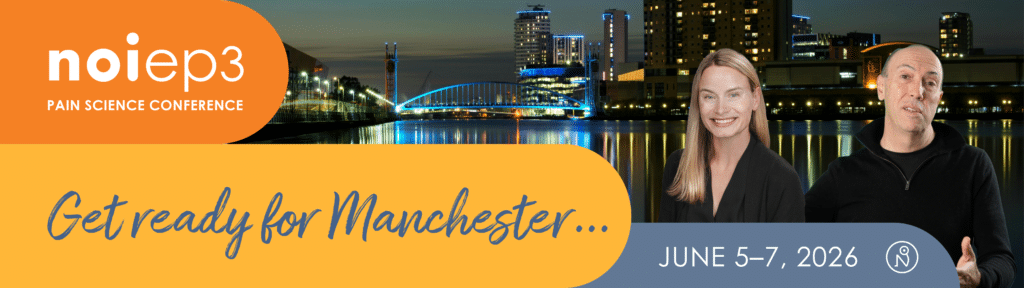
If you’re in the UK area in 2026, EP3 is coming to Manchester, and we’d love for you to join us. You can find more info HERE.
A reflection of my experience at EP3 2025
It is quite a task to summarise your biggest take-home message following a three-day EP3 Conference. However, I believe these two words come closest to summing it up: ‘Hope’ and ‘Trust’. Hope that things can get better – that we are not stationary entities, but ever-moving processes. And, trust in our own bodies; call it what you will: self-efficacy, an internal locus of control, confidence in our bodies’ abilities to adapt and change, and to be ‘fit for the very next moment’.
So simple, but so profound. A quote I love, and have often found valid, goes: “If I tell you something, and it’s like you’ve known it all along, it’s truth”, because intuitively, the message is already understood.
That hope and trust matter so much makes perfect sense. Yet, in healthcare practice, the ability to give people control over their own health – the ability to confidently make decisions and to regain faith in their own bodies, and to empower them to feel comfortable in the presence of a measure of mystery and uncertainty – can be an elusive skill.
We, as health professionals, may unwittingly and unconsciously, even while exercising our practices to the best of our abilities, be barriers to our clients hearing these vital messages. The ‘Protectometer’ obtains a new meaning when you realise that you can just as easily be a DIM to your client as a SIM.
EP3 was a three-day invitation to think more deeply about our practices, our communication, the messages we want to convey to our clients, and the ones we may not even know we are conveying. Further, it was an invitation to consider carefully what motivates our practices and what theories or internal models they are based on. It invited us to consider, perhaps the biggest question, whether we fully believe in our clients’ bodies, their bioplasticity and ability to change and adapt constantly.
During the three days, I noticed that what I learned went deeper than what I could use with my clients in day-to-day practice. I noticed subtle changes in my own outlook and reasoning (perhaps the beginnings of constructivism?), reduced despondency in my ability to make a difference – even when considering chronic health conditions – and a rekindled sense of optimism about the results that can be achieved through conservative treatment.
I am not sure what the greatest factor was: the presentations on ongoing, incredible research which defy logic with regards to abilities of the human body to heal and adapt; the development of state of the art tools to aid pain education; the speakers with their years of experience, vast knowledge and surprisingly entertaining teaching methods (who knew pain education could be fun??); the touching personal stories of recovery which were shared; the sheer volume of like-minded individuals from varied allied health backgrounds; or whether it was all of the above. All I know is, at the end of three days, I felt more excited about what I can offer and what my clients can achieve than I had in a while.
Thank you, NOI, for an unforgettable experience. I hope and trust that you will continue your life-changing work for many years to come.
– Freda du Plessis
comments